


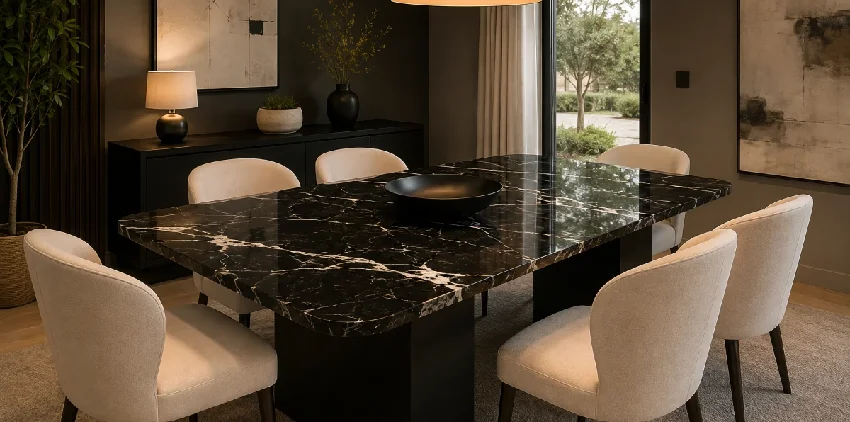
Before You Buy a Marble Dining Table, Ask Yourself These 8 Questions
You see it across the showroom and immediately imagine it at home. The veining looks dramatic, the surface catches the light, and suddenly your dining room feels designed for marble. But before excitement turns into a purchase, there is another scene worth picturing: weekday breakfasts, spilled drinks, crowded dinners, moving chairs, and years of everyday use. A marble dining table can completely reshape a room, yet the right choice depends on far more than appearance. Ask the right questions now, and you can choose a table that looks striking on arrival and continues making sense long after the excitement settles.
Why Marble Deserves More Than a Quick Decision
Marble has presence. Even in a simply decorated room, its natural pattern can draw attention and create an immediate focal point. No two slabs look exactly alike, giving each table a character that manufactured surfaces often struggle to imitate.
That visual appeal, however, can make shoppers decide with their eyes before considering how the table will actually function.
A dining table becomes part of everyday life. It hosts meals, conversations, celebrations, coffee cups, homework, takeaway boxes, and occasionally everything at once. Marble can handle that role beautifully when its characteristics match your expectations.
Before choosing a design because the showroom lighting made you fall in love, answer these eight questions:
1. Does Marble Actually Suit My Lifestyle?
Start with the question that product photographers cannot answer.
If dinners are usually calm, organized affairs and everyone naturally uses coasters and place-mats, marble may fit easily into your routine. If your dining space doubles as a busy family hub where spills, crafts, work, and spontaneous gatherings happen consistently, you will need to be comfortable with a little more attention.
Marble is natural stone, and certain substances can stain or etch its surface. Acidic liquids can be particularly troublesome when left sitting.
This doesn’t mean marble belongs only in rooms that nobody touches. It simply means expectations matter too. A table should complement your habits rather than make you nervous every time someone lifts a glass.
Picture an ordinary week, not an imaginary dinner party. If marble still feels right in that scene, keep exploring.
2. How Much Space Do I Really Have?
Here is where enthusiasm meets the measuring tape.
A table can look ideally proportioned in a spacious showroom and surprisingly enormous once delivered into a smaller dining room. Marble also has considerable visual weight, so its presence can make an over-sized design feel more dominant.
Measure the available floor area before shopping. Then account for dining chairs and the space required to pull them out comfortably. People should be able to sit down, stand up, and move around without turning dinner into an obstacle course.
Also consider nearby cabinets, doorways, kitchen islands, and walking routes.
Marking the proposed dimensions on your floor with removable tape can help you understand how much territory will the table occupy.
Choose dimensions that tend to work beautifully during everyday life, then find flexible solutions when additional guests arrive.
3. Which Shape Works With My Room?
Round, oval, square, or rectangular? The thing is: shape affects far more than appearance itself.
A rectangular marble dining table can work naturally in longer rooms and often provides generous seating. Round tables can encourage conversation while softening spaces that are dominated by straight architectural lines. Oval designs offer some of that softness while retaining useful length.
Square tables can create pleasing symmetry in appropriately shaped rooms, although larger versions may make conversation across the table feel less intimate.
Look at your room before looking at trends.
If circulation feels tight, rounded edges may make movement easier. If your dining area is narrow, a broad round table could consumer valuable walking space. If the room is large and open, a substantial rectangular design may create the anchor it needs.
The right shape should look intentional while allowing the room to breathe. Beautiful furniture becomes frustrating when its proportions constantly interrupt movement.
4. What Kind of Marble Am I Choosing?
“Marble” sounds like one straightforward category until you start shopping.
Different varieties offer different colors, veining patterns, visual intensity, and characteristics. Some surfaces appear soft and subtle, while others feature bold lines that immediately command attention.
Instead of choosing by name alone, look closely at the actual slab or surface whenever possible. Natural variation means the table you receive may not ideally mirror a sample photograph.
Ask the seller what type of marble is used and whether the table features solid marble, a marble surface attached to another material, or a marble-look alternative. Those constructions are not interchangeable. Understanding exactly what you are purchasing helps you compare options more meaningfully.
The pattern matters too. Quiet veining can blend easily with evolving interiors, while dramatic marble can function like artwork. Decide whether you want your table to support the room or become its defining visual statement.
5. Am I Comfortable With Natural Variation?
This question can prevent disappointment later.
Natural marble is not designed to look ideally uniform. Veins shift, tones vary, and markings can appear differently across individual slabs. That unpredictability is part of its appeal.
Natural marble is not designed to look ideally uniform. Veins shift, tones vary, and markings can appear differently across individual slabs. That unpredictability is part of its appeal.
Before purchasing, decide what you actually expect. If you want every line and shade to match a catalog image precisely, natural marble may challenge that expectation. If you appreciate surfaces with individual character, those differences can make your table feel distinctive.
When shopping online, read the product information closely and ask whether the images represent the exact table, a sample slab, or a general example.
When shopping in person, examine the surface from multiple angles and under different lighting conditions.
Marble asks you to embrace unpredictability. For many interiors, that is exactly where its visual charm begins.
6. What Does Maintaining Marble Involve?
A marble table should look inviting, not become a source of constant anxiety. Understanding maintenance before buying helps establish realistic expectations.
Spills should generally be addressed promptly, particularly when they involve acidic or strongly colored substances. Gentle cleaning methods are preferable to harsh products that may affect the surface.
Depending on the marble and finish, sealing may also be recommended periodically. Ask the seller what the specific table requires rather than assuming every marble surface behaves identically.
Consider your willingness to use place-mats, coasters, trivets, or table coverings when appropriate. These simple habits can help reduce unnecessary marks while allowing the natural surface to stay visible.
The main goal is not to stay obsessive about the table but to protect it responsibly.
Instead, understand the material and decide whether its everyday requirements feel compatible with your household before purchasing.
7. Will the Base Support the Look and the Table?
It is easy to become so distracted by marble veining that the base becomes an afterthought. That is a mistake.
The base affects stability, legroom, seating flexibility, and the overall personality of the table. Pedestal designs can create a sculptural appearance and may reduce awkward encounters with table legs. Four-leg structures can feel visually familiar and provide straightforward support. Metal, timber, and stone bases each change the character of the marble above them.
Sit at the table before purchasing whenever possible. Check where your knees naturally fall and whether chairs can be positioned comfortably.
Also examine how the base distributes the considerable weight of the surface.
A striking table surface deserves a structure that feels equally convincing. Think of the base as part of the design rather than hidden engineering. When both elements work in unison, the table feels resolved from every angle.
8. How Will It Work With My Existing Interior?
Your marble dining table does not arrive in an empty room.
It enters a space containing flooring, lighting, chairs, wall colors, cabinetry, artwork, and other materials. The successful choice is one that creates conversation between those elements rather than competing with them.
Look at the undertones in the marble. Warmer veining can connect beautifully with timber and earthy colors, while cooler tones may sit naturally alongside metal, glass, charcoal, or crisp neutrals.
Contrast can also be powerful. A sleek marble surface can bring definition to a room filled with softer textures. Timber chairs can make cool stone feel more inviting.
Before buying, save photographs of your dining area and compare them with the table. Better still, gather samples of nearby colors and materials.
You are not selecting an isolated object. You are choosing the visual anchor around which the rest of your dining story will unfold.
Make the Purchase With Your Eyes Open
By now, that beautiful marble table in the showroom should look a little different.
You can still admire the veining and imagine the dinners ahead, bit now you are seeing the complete picture: dimensions, shape, construction, maintenance, natural variation, base design, surrounding decor, and everyday habits.
That knowledge doesn’t remove the excitement. It makes the excitement useful.
The bottom-line is: a marble dining table can become an extraordinary centerpiece when chosen for the life happening around it rather than appearance alone.